Buy gamingstate.eu ?
We are moving the project
gamingstate.eu .
Are you interested in purchasing the domain
gamingstate.eu ?
domain@kv-gmbh.de · 0541-91531010
Buy gamingstate.eu ?
What is the braking deceleration?
Braking deceleration refers to the rate at which a vehicle slows down when the brakes are applied. It is measured in meters per second squared (m/s^2) and represents the negative acceleration experienced by the vehicle as it comes to a stop. The braking deceleration depends on factors such as the vehicle's mass, the friction between the tires and the road, and the force applied to the brakes. A higher braking deceleration means the vehicle will come to a stop more quickly. **
How do I calculate the deceleration?
To calculate deceleration, you need to determine the change in velocity and the time it takes for that change to occur. Deceleration is calculated by dividing the change in velocity by the time taken for the change to happen. The formula for deceleration is: deceleration = (final velocity - initial velocity) / time. Make sure to use consistent units for velocity and time in your calculation. **


Similar search terms for Deceleration
Top-Angebote
Products related to Deceleration:
-
DJI Osmo Action 4 Adventure Combo Camera BlackThe DJI Osmo 4 excels in low light, all thanks to a 1/1.3” image sensor with wide f/2.8 aperture . You'll see more detail in every frame, from sun-up to sundown and beyond. Light up your socials with unique perspectives – the 155° super-wide FOV feels super engaging as you'll see more of the action while showing off the spectacular scenery. Movement looks smooth and scenes are packed with detail when shooting at 4K/120fps . RockSteady 3.0 stabilisation puts an end to unusable shaky footage. Instead you can grab some amazing first-person perspectives. There's also HorizonSteady which keeps your video horizontally level, even though heavy bumps and 360° rotations. Good to know - The colour temperature sensor intelligently adjusts white balance and AE for highly accurate colours, even in difficult lighting environments - It's built to handle cold weather, so you can keep recording for up to 150 minutes in temperatures as low as -20°C (-4°F) - It's easy to detach with the quick-release system – and switch from horizontal to vertical in seconds - Go deeper with waterproofing up to 18 metres (59 ft) without the need for extra accessories - Dual touchscreens come in handy for vlogging, framing selfies, and tweaking settings from the front DJI Osmo Action 4 Adventure Combo 4K Ultra HD Action Camera - Black, 4K Ultra HD video (120 fps), 155° lens, Waterproof to 18 m, Built-in WiFi / Bluetooth, Front & back touchscreens, 10 megapixel still photos & time lapse mode241,49 £*Shipping: 0,00 £Secure redirect to the provider
-
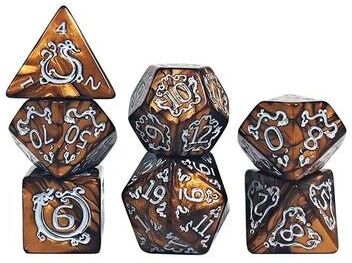
Inspired Finds 7 Piece Dragon Pattern Polyhedral Dice Set For Tabletop Role Playing Games pinkBring fantasy style to every campaign with this dragon pattern dice set, featuring seven polyhedral dice designed for tabletop roleplaying games, board games, and collectible displays. Each die showcases an eyecatching dragoninspired design that...34,99 $*Shipping: 0,00 $Secure redirect to the provider
-
Inspired Finds 7 Piece Dragon Pattern Polyhedral Dice Set For Tabletop Role Playing Games khakiBring fantasy style to every campaign with this dragon pattern dice set, featuring seven polyhedral dice designed for tabletop roleplaying games, board games, and collectible displays. Each die showcases an eyecatching dragoninspired design that...34,99 $*Shipping: 0,00 $Secure redirect to the provider



-
How do you calculate the braking deceleration?
To calculate the braking deceleration, you need to know the initial velocity of the object, the final velocity (usually 0 if the object comes to a stop), and the time it takes for the object to come to a stop. The formula to calculate deceleration is: deceleration = (final velocity - initial velocity) / time. By plugging in the values for final velocity, initial velocity, and time into this formula, you can calculate the braking deceleration of the object. **
-
How does uniform deceleration work in physics?
Uniform deceleration in physics refers to a constant decrease in velocity over time. This means that the object is slowing down at a consistent rate. The rate of deceleration is measured in terms of acceleration, with a negative sign to indicate that it is in the opposite direction of the initial velocity. This can be represented by the equation a = (vf - vi) / t, where a is the acceleration, vf is the final velocity, vi is the initial velocity, and t is the time taken. Uniform deceleration is important in understanding the motion of objects and can be used to calculate stopping distances and braking forces in real-world scenarios. **
-
Friction on an inclined plane causes deceleration.
Friction on an inclined plane causes deceleration because it acts in the opposite direction of the object's motion. As the object moves up or down the incline, the friction force opposes its movement, reducing its speed. This deceleration is due to the friction force converting the object's kinetic energy into heat. The steeper the incline or the greater the coefficient of friction, the stronger the deceleration will be. **
-
What is the deceleration of the brakes 2?
The deceleration of brakes 2 is 5 m/s^2. This means that the brakes are slowing down the car at a rate of 5 meters per second squared. A higher deceleration value indicates a stronger braking force, which can help the car come to a stop more quickly. It is important for drivers to be aware of the deceleration of their brakes to ensure safe and efficient stopping. **


What is the formula for deceleration in physics?
The formula for deceleration in physics is given by the equation: a = (v - u) / t, where a is the deceleration, v is the final velocity, u is the initial velocity, and t is the time taken. This formula calculates the rate at which an object slows down, or decelerates, over a certain period of time. Deceleration is a negative acceleration, so the value obtained from the formula will be negative, indicating a decrease in velocity. **
How do you calculate the braking deceleration 2?
To calculate the braking deceleration 2, you can use the formula: a = (v_f - v_i) / t, where a is the deceleration, v_f is the final velocity, v_i is the initial velocity, and t is the time taken to decelerate. First, determine the initial and final velocities of the object. Then, measure the time it takes for the object to come to a complete stop. Finally, plug these values into the formula to calculate the braking deceleration 2. **
Top-Angebote
Products related to Deceleration:
-
Inspire Daily Merch Balloon Explosion Game Fun Party Tabletop Toy Multiplayer For Family Gatherings And Adventure Balloon Explosion Game Fun Party Tabletop Toy Multiplayer For Family Gatherings And AdventureUnleash the Fun with the Multiplayer Balloon Explosion Game The Multiplayer Balloon Explosion Game is the ultimate tabletop toy for unforgettable moments. Designed to get everyone involved, this game is perfect for both kids and adults, offering...79,97 $*Shipping: 0,00 $Secure redirect to the provider
-
DJI Osmo Action 5 Pro Adventure ComboCapture every adventure in stunning detail with this advanced 4K Action Camera with 1/1.3" CMOS Sensor, designed for creators who want professional-quality results in a compact and durable form. Equipped with a powerful 1/1.3" CMOS sensor, it delivers exceptional image clarity and low-light performance, allowing you to record 4K video at up to 120fps for ultra-smooth motion and cinematic slow-motion playback. You can also capture breathtaking 40-megapixel still images, enhanced by an impressive 13.5 stops of dynamic range, ensuring rich detail in both highlights and shadows. The 155° ultra-wide field of view lets you capture more of the scene, making it perfect for action shots, travel, and immersive storytelling. With advanced digital stabilisation, your footage remains smooth and steady even in high-motion environments, whether you're cycling, skiing, or exploring the outdoors. For creative control, the camera includes D-Log M colour profile and multiple HDR modes, giving you greater flexibility in post-production and allowing you to achieve professional-grade colour and contrast. Built for long shooting sessions, the battery offers up to 3–4 hours of recording time on a single charge, so you can keep filming without interruption. Compact, powerful, and versatile, this action camera is the ideal companion for capturing life’s most exciting moments with precision and style.386,99 £*Shipping: 0,00 £Secure redirect to the provider
-
DJI Osmo Action 4 Adventure Combo Camera BlackThe DJI Osmo 4 excels in low light, all thanks to a 1/1.3” image sensor with wide f/2.8 aperture . You'll see more detail in every frame, from sun-up to sundown and beyond. Light up your socials with unique perspectives – the 155° super-wide FOV feels super engaging as you'll see more of the action while showing off the spectacular scenery. Movement looks smooth and scenes are packed with detail when shooting at 4K/120fps . RockSteady 3.0 stabilisation puts an end to unusable shaky footage. Instead you can grab some amazing first-person perspectives. There's also HorizonSteady which keeps your video horizontally level, even though heavy bumps and 360° rotations. Good to know - The colour temperature sensor intelligently adjusts white balance and AE for highly accurate colours, even in difficult lighting environments - It's built to handle cold weather, so you can keep recording for up to 150 minutes in temperatures as low as -20°C (-4°F) - It's easy to detach with the quick-release system – and switch from horizontal to vertical in seconds - Go deeper with waterproofing up to 18 metres (59 ft) without the need for extra accessories - Dual touchscreens come in handy for vlogging, framing selfies, and tweaking settings from the front DJI Osmo Action 4 Adventure Combo 4K Ultra HD Action Camera - Black, 4K Ultra HD video (120 fps), 155° lens, Waterproof to 18 m, Built-in WiFi / Bluetooth, Front & back touchscreens, 10 megapixel still photos & time lapse mode241,49 £*Shipping: 0,00 £Secure redirect to the provider
-
What is the braking deceleration?
Braking deceleration refers to the rate at which a vehicle slows down when the brakes are applied. It is measured in meters per second squared (m/s^2) and represents the negative acceleration experienced by the vehicle as it comes to a stop. The braking deceleration depends on factors such as the vehicle's mass, the friction between the tires and the road, and the force applied to the brakes. A higher braking deceleration means the vehicle will come to a stop more quickly. **
-
How do I calculate the deceleration?
To calculate deceleration, you need to determine the change in velocity and the time it takes for that change to occur. Deceleration is calculated by dividing the change in velocity by the time taken for the change to happen. The formula for deceleration is: deceleration = (final velocity - initial velocity) / time. Make sure to use consistent units for velocity and time in your calculation. **
-
How do you calculate the braking deceleration?
To calculate the braking deceleration, you need to know the initial velocity of the object, the final velocity (usually 0 if the object comes to a stop), and the time it takes for the object to come to a stop. The formula to calculate deceleration is: deceleration = (final velocity - initial velocity) / time. By plugging in the values for final velocity, initial velocity, and time into this formula, you can calculate the braking deceleration of the object. **
-
How does uniform deceleration work in physics?
Uniform deceleration in physics refers to a constant decrease in velocity over time. This means that the object is slowing down at a consistent rate. The rate of deceleration is measured in terms of acceleration, with a negative sign to indicate that it is in the opposite direction of the initial velocity. This can be represented by the equation a = (vf - vi) / t, where a is the acceleration, vf is the final velocity, vi is the initial velocity, and t is the time taken. Uniform deceleration is important in understanding the motion of objects and can be used to calculate stopping distances and braking forces in real-world scenarios. **
Similar search terms for Deceleration
-
Inspired Finds 7 Piece Dragon Pattern Polyhedral Dice Set For Tabletop Role Playing Games pinkBring fantasy style to every campaign with this dragon pattern dice set, featuring seven polyhedral dice designed for tabletop roleplaying games, board games, and collectible displays. Each die showcases an eyecatching dragoninspired design that...34,99 $*Shipping: 0,00 $Secure redirect to the provider
-
Inspired Finds 7 Piece Dragon Pattern Polyhedral Dice Set For Tabletop Role Playing Games khakiBring fantasy style to every campaign with this dragon pattern dice set, featuring seven polyhedral dice designed for tabletop roleplaying games, board games, and collectible displays. Each die showcases an eyecatching dragoninspired design that...34,99 $*Shipping: 0,00 $Secure redirect to the provider
-
Inspired Finds 7 Piece Dragon Pattern Polyhedral Dice Set For Tabletop Role Playing Games plumBring fantasy style to every campaign with this dragon pattern dice set, featuring seven polyhedral dice designed for tabletop roleplaying games, board games, and collectible displays. Each die showcases an eyecatching dragoninspired design that...34,99 $*Shipping: 0,00 $Secure redirect to the provider
-
Inspired Finds 7 Piece Dragon Pattern Polyhedral Dice Set For Tabletop Role Playing Games blueBring fantasy style to every campaign with this dragon pattern dice set, featuring seven polyhedral dice designed for tabletop roleplaying games, board games, and collectible displays. Each die showcases an eyecatching dragoninspired design that...34,99 $*Shipping: 0,00 $Secure redirect to the provider
-
Friction on an inclined plane causes deceleration.
Friction on an inclined plane causes deceleration because it acts in the opposite direction of the object's motion. As the object moves up or down the incline, the friction force opposes its movement, reducing its speed. This deceleration is due to the friction force converting the object's kinetic energy into heat. The steeper the incline or the greater the coefficient of friction, the stronger the deceleration will be. **
-
What is the deceleration of the brakes 2?
The deceleration of brakes 2 is 5 m/s^2. This means that the brakes are slowing down the car at a rate of 5 meters per second squared. A higher deceleration value indicates a stronger braking force, which can help the car come to a stop more quickly. It is important for drivers to be aware of the deceleration of their brakes to ensure safe and efficient stopping. **
-
What is the formula for deceleration in physics?
The formula for deceleration in physics is given by the equation: a = (v - u) / t, where a is the deceleration, v is the final velocity, u is the initial velocity, and t is the time taken. This formula calculates the rate at which an object slows down, or decelerates, over a certain period of time. Deceleration is a negative acceleration, so the value obtained from the formula will be negative, indicating a decrease in velocity. **
-
How do you calculate the braking deceleration 2?
To calculate the braking deceleration 2, you can use the formula: a = (v_f - v_i) / t, where a is the deceleration, v_f is the final velocity, v_i is the initial velocity, and t is the time taken to decelerate. First, determine the initial and final velocities of the object. Then, measure the time it takes for the object to come to a complete stop. Finally, plug these values into the formula to calculate the braking deceleration 2. **
* All prices are inclusive of VAT and, if applicable, plus shipping costs. The offer information is based on the details provided by the respective shop and is updated through automated processes. Real-time updates do not occur, so deviations can occur in individual cases. ** Note: Parts of this content were created by AI.